Off the clock
A runner’s life in numbers.
Fifteen years. Every run logged.
- runs
- 3,792 runs
- kilometres
- 35,176 kilometres
- metres climbed
- 955,117 metres climbed
- Everests
- 108 Everests
It started on New Year’s Eve 2010: one slow hour up Mount Kaukau, less than six kilometres, logged on a phone app because even then, if it wasn’t logged, it didn’t happen. I was thirty-one, it nearly killed me, and I noted the numbers anyway. That instinct (measure it, then beat it) turned out to be the whole sport for me.
Running and data were never separate hobbies. The spreadsheet brain loved the trails as much as the legs did: split times studied like financial reports, eighty-five logged attempts at one Strava segment before the crown finally fell, a flat one-kilometre loop at Karori Park run more than a thousand times because controlled conditions make clean experiments. Three full marathons run entirely inside that loop. The data wasn’t a record of the running. It was the method.
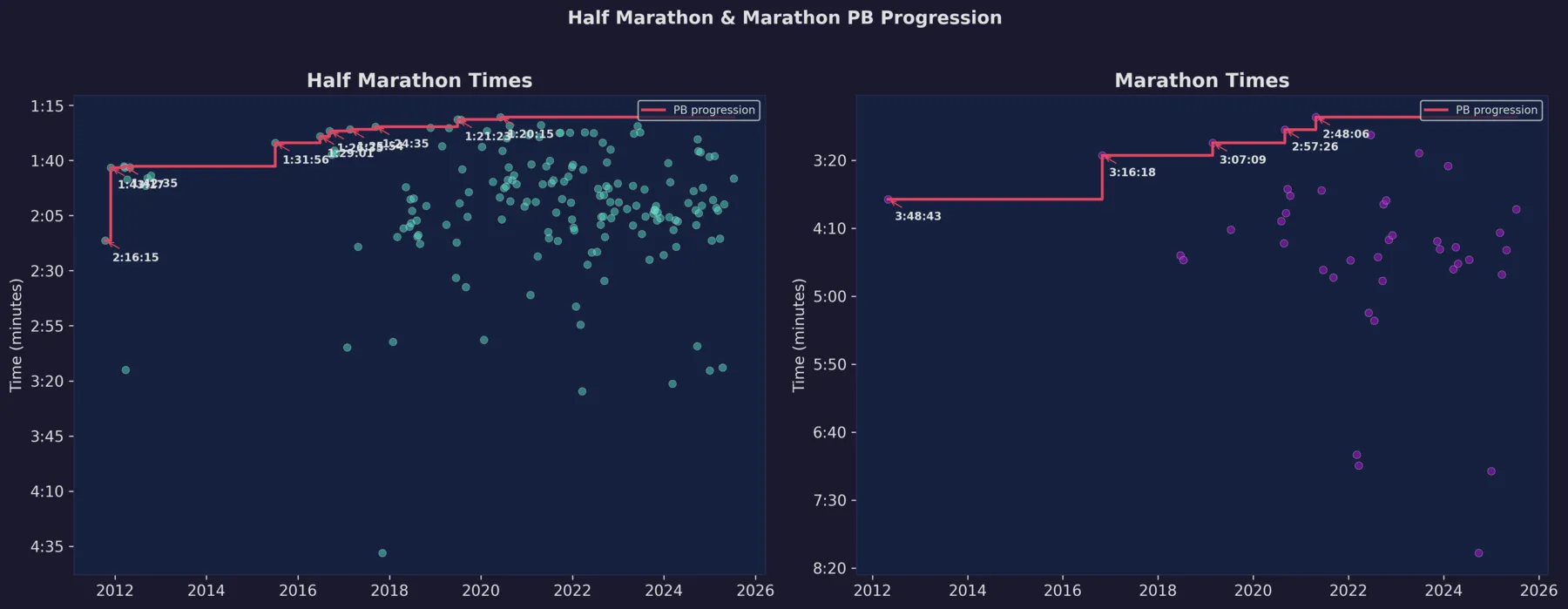
And the method worked, at an age when it supposedly shouldn’t. The half marathon fell from 2:16 to 1:19. I won my first race at thirty-nine, then kept winning them. The marathon PB (2:48:06, forty-two monotonous laps of K-Park on Anzac Day) came at forty-one, a decade and a half after that first wheezing Kaukau climb. Second place at the Taupo 100k the same year the body turned forty-one. The charts all said the same heretical thing: potential doesn’t expire on schedule. You just have to keep feeding it data.
The later years went long: the WUU2k ultras over Wellington’s skyline, Kepler, a winter circuit of Tongariro in fresh snow, and in April 2025 the longest day of all: the Faultline, 106.5 km and fourteen hours of will power, one close friend at every aid station who then walk-jogged the final 30 km beside me, and a finish line I’d owed myself since a 96 km DNF the year before. Three months later I won my last race, a threepeat at the Akatarawas.
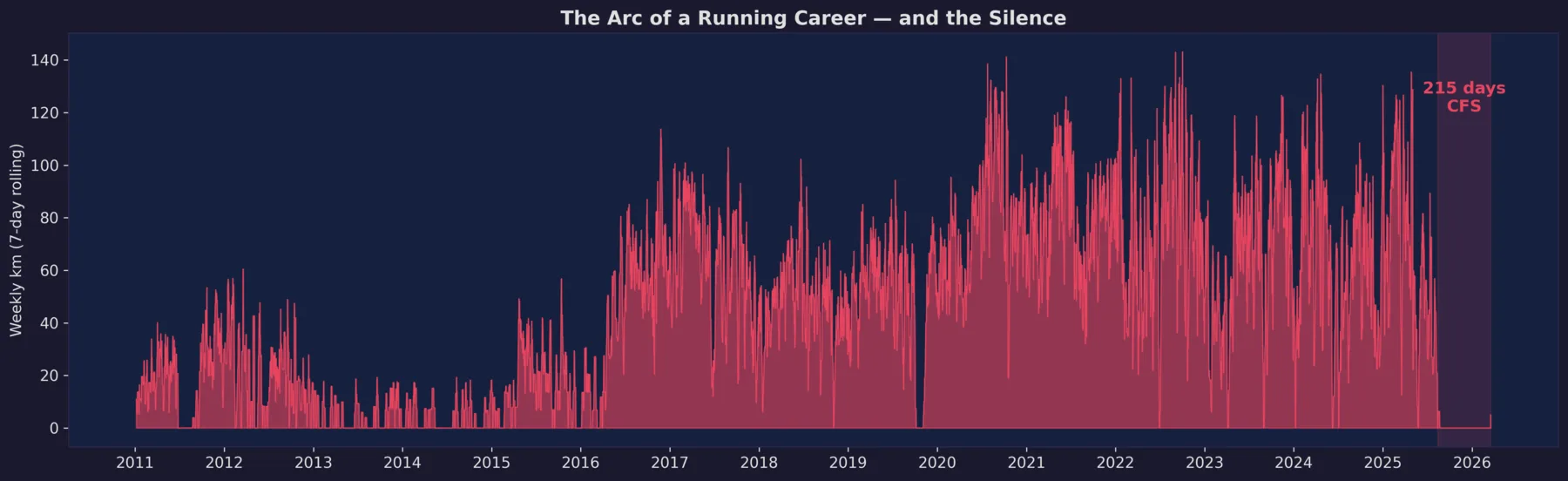
Then, July 2025: a virus. The last entry before the silence is dated 14 August: 6.3 km, titled “Fence check”, with a note that reads “keeping effort easy while recovering from some virus. Any effort seems to ruin me for a few days.” Then nothing. The longest gap in fifteen years of logging had been 79 days; this one ran to 215 before a single cautious entry appeared: five flat kilometres along the waterfront with a friend who’d waited seven months to run them with me. It cost two weeks of headaches. What started as a virus has a name now, chronic fatigue, and it doesn’t negotiate. Eleven months in, the training plan is yoga, patience, and the same discipline the logs taught me: respect what the data says the body can absorb today.
The watch is still on the wrist, though these days it mostly runs my games. The shoes wait on the rack with the fourteen others in the quiver. And the comeback, whenever it comes, will be logged from the very first kilometre. I even built the companion for it.